This page includes examples of common MLA (Modern Language Association) citation formats based on the 9th edition (2021) of the MLA Handbook. MLA Style is widely used in humanities courses like English and literature. It ensures consistent source citation, helping you avoid plagiarism and making your research easier to follow.
The 9th edition of the MLA Handbook offers examples and clearer guidance to help students cite a wide variety of sources, Some of the changes include:
MLA may look different depending on the type of source you're citing, but the rules are designed to stay flexible and easy to apply.
👉 For step-by-step instructions and examples, see the MLA Quick Guide.
Explore these trusted resources for more examples and templates:

MLA Handbook by The Modern Language; The Modern Language Association of America
Call Number: LB 2369.G53 2021
ISBN: 9781603293518
Publication Date: 2021-05-30
📌 Tip: Copies of the MLA Handbook (9th edition) are available at all campus locations:
Wharton Campus – Library and Learning Center, Room L-107D
Richmond Campus – Learning Center, Room 142
Sugar Land Campus – Learning Center, Room SGL-279
Bay City Campus – Front Desk, Main Lobby
When to Use In-Text Citations
In MLA style, include an in-text citation whenever you quote, paraphrase, or refer to someone else’s ideas.
How MLA In-Text Citations Work
Citations usually show the author’s last name and page number in parentheses, like (Smith 45). If the author’s name is already in your sentence, just include the page number: Smith argues that… (45).
Example paragraph with in-text citations
A few researchers in the linguistics field have developed training programs designed to improve native speakers' ability to understand accented speech (Derwing et al. 246; Thomas 15). Their training techniques are based on the research described above indicating that comprehension improves with exposure to non-native speech. Derwing and others conducted their training with students preparing to be social workers, but note that other professionals who work with non-native speakers could benefit from a similar program (258).
Works Cited List
Derwing, Tracey M., et al. "Teaching Native Speakers to Listen to Foreign-accented Speech." Journal of Multilingual and Multicultural Development, vol. 23, no. 4, 2002, pp. 245-259.
Thomas, Holly K. Training Strategies for Improving Listeners' Comprehension of Foreign-accented Speech. University of Colorado, Boulder, 2004.


The Works Cited page appears at the end of your paper.
It begins on a new page.
List your sources in alphabetical order by author. If the author is unknown, alphabetize by title ignoring any initial A, An or The.
Use a hanging indent for any entry longer than one line.
Continue the heading in the upper right-hand corner - Your Last Name space Page Number - and continue the page numbering from the body of the paper.
Continue 1 in margins and double-spacing throughout the paper including the Works Cited page.

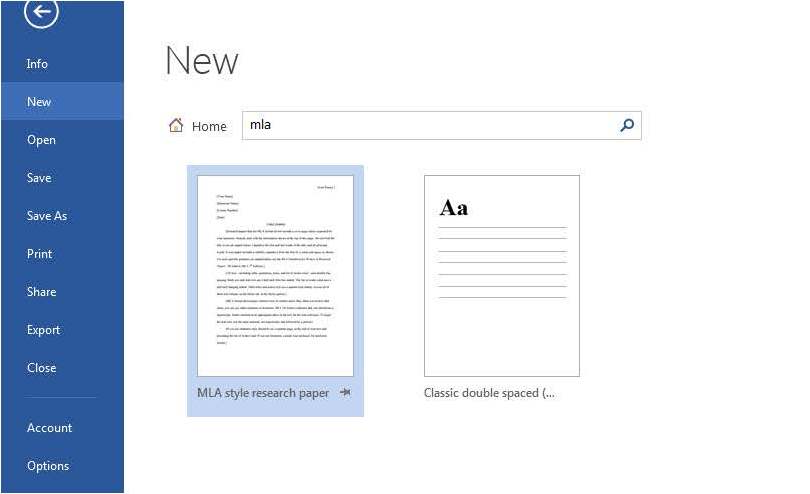
File - New - type 'mla' in search bar - choose template (double-click)
If you want to use the same template for future uses, just 'pin it' and it will be available whenever you choose New; no need to search for it again.